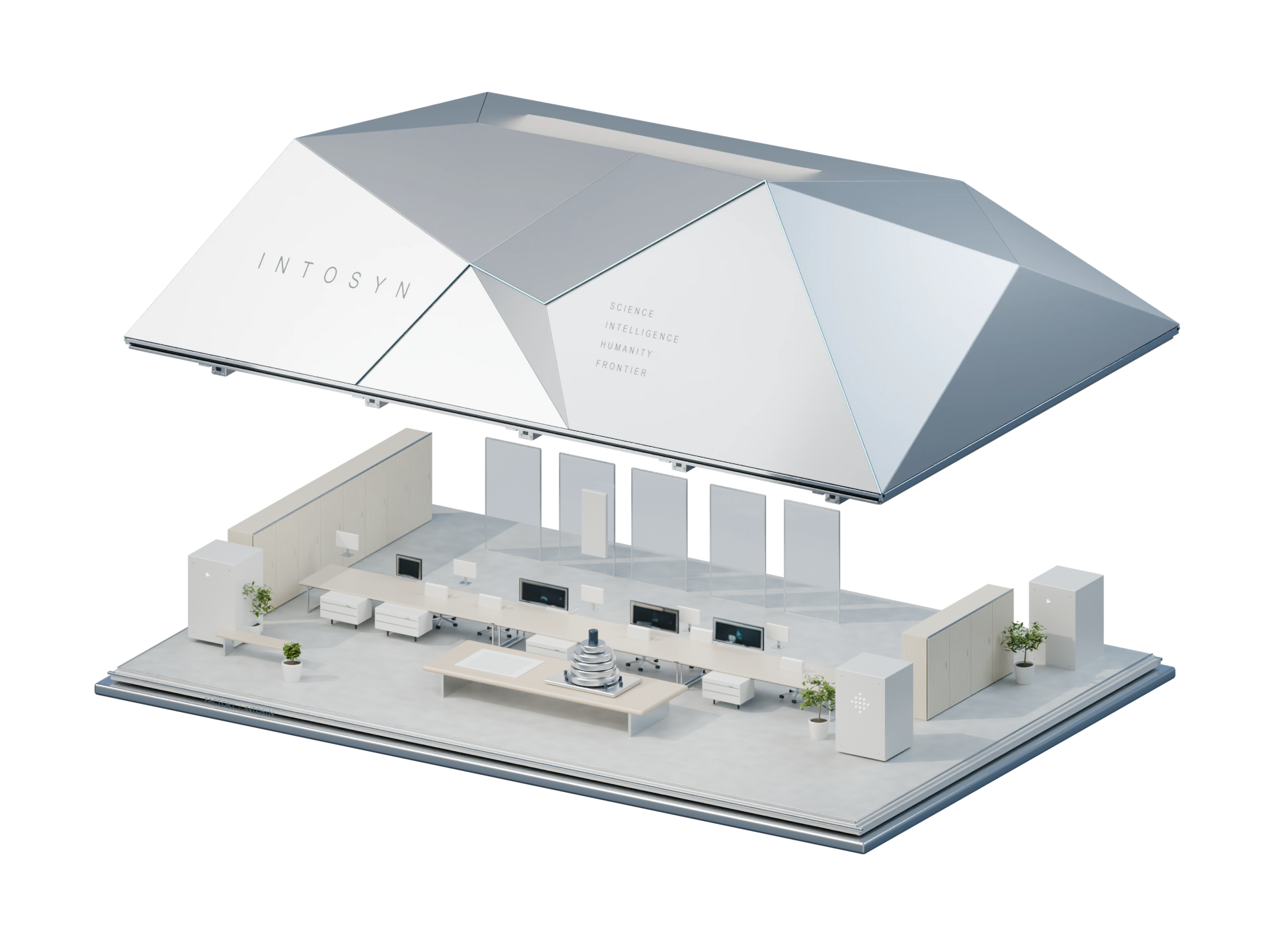
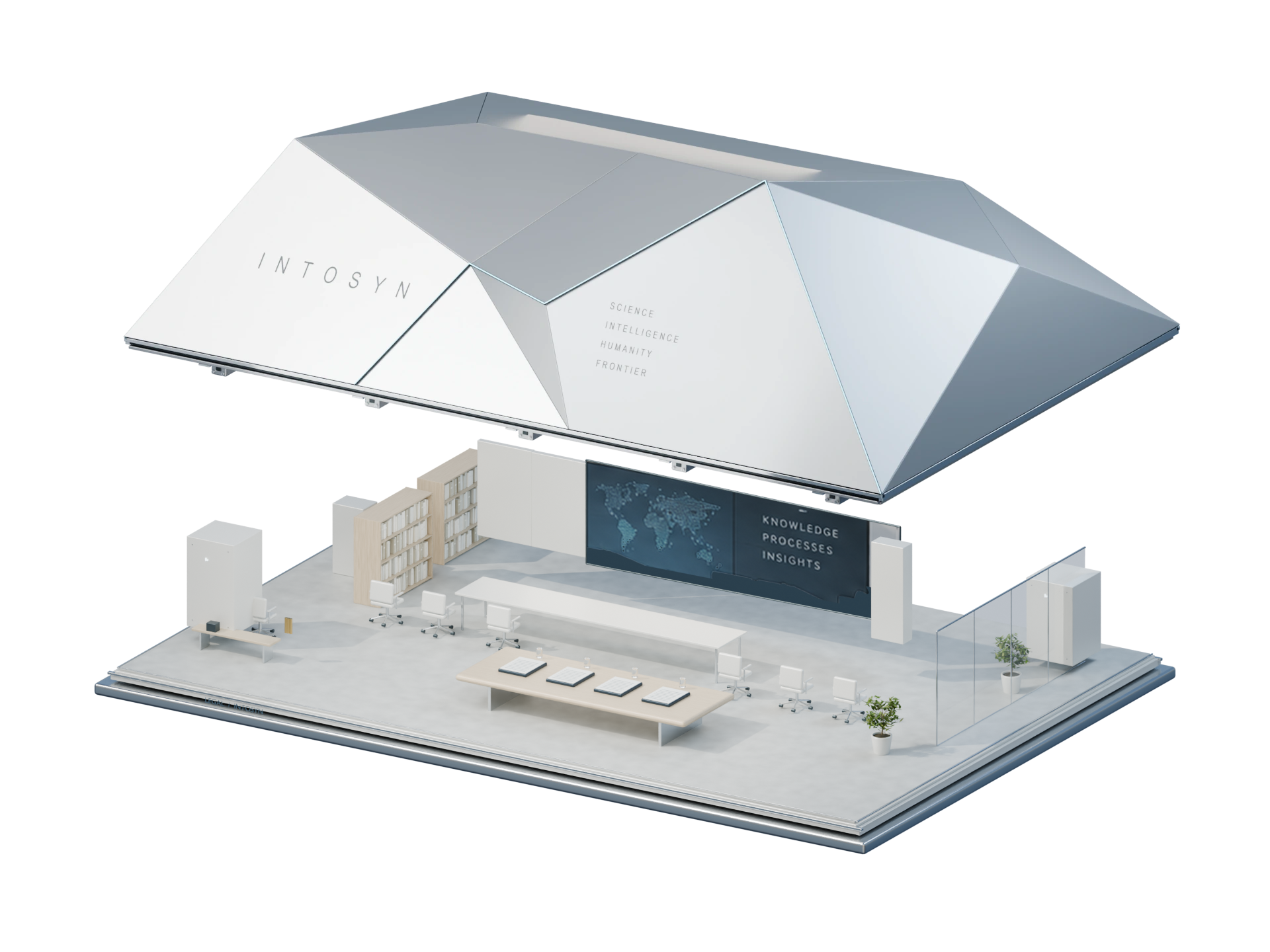
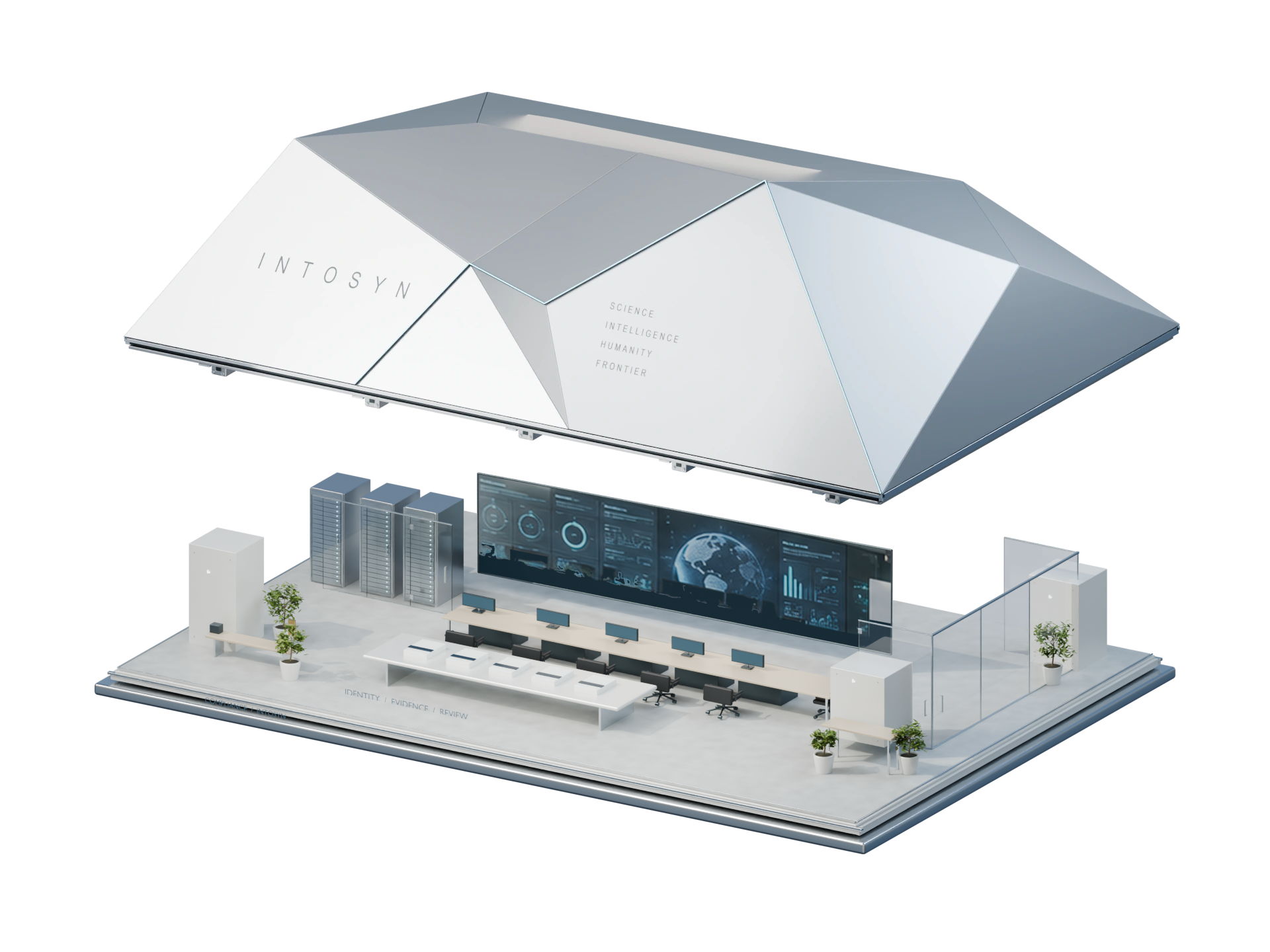
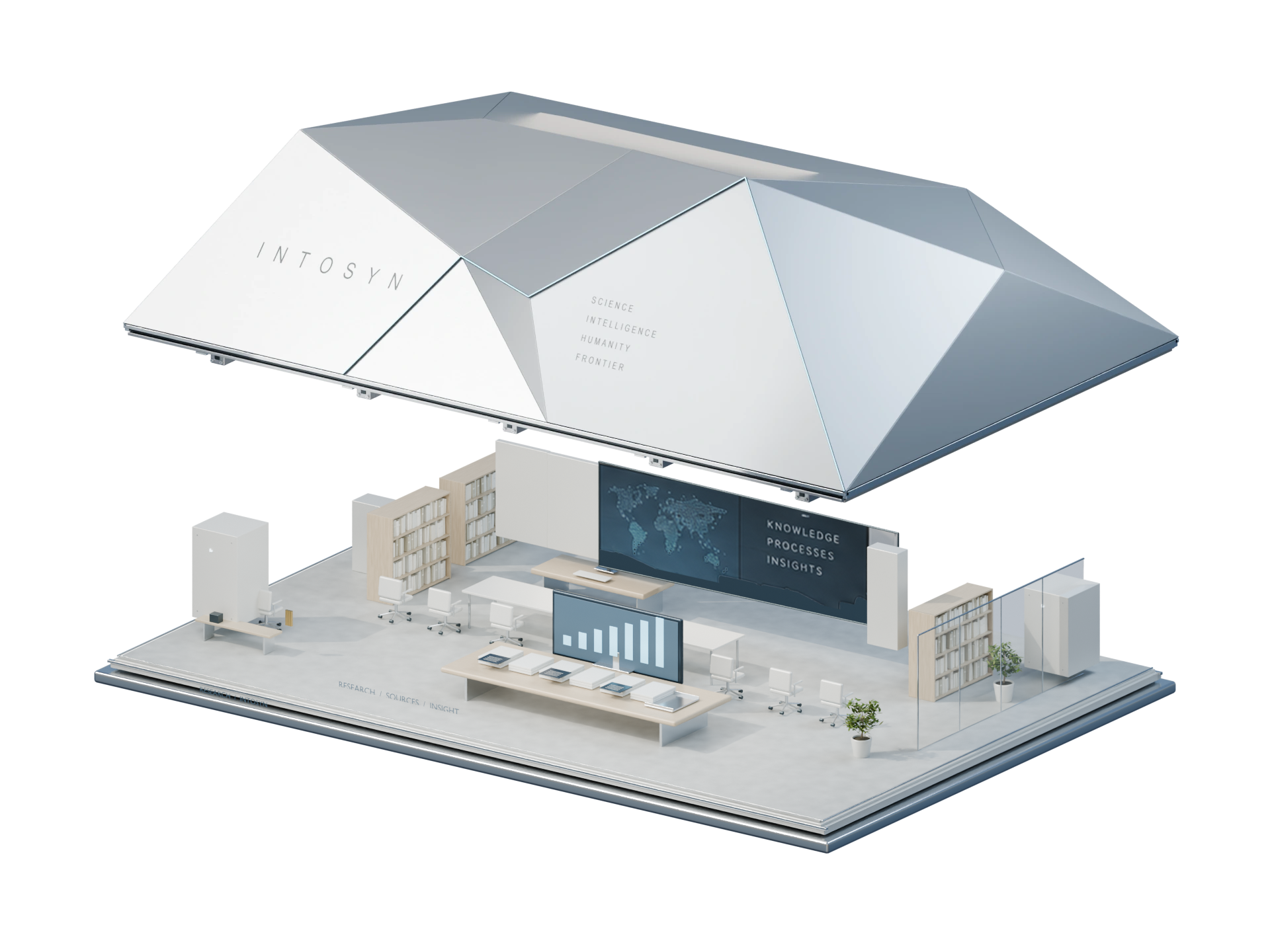
INTOSYN enterprise AI architecture, unfolding knowledge, work, collaboration and compute

Knowledge & experienceStandards · Cases · Knowledge
Professional workTools · Drawings · Execution
Collaboration & reviewCoordination · Access · Review
Compute & dataCloud · Private deployment · Hardware

INTOSYN / APPLIED INTELLIGENCE

From enterprise knowledge
to executable intelligence

Connect your enterprise knowledge to the systems and tools your teams use. We build custom AI agents that retrieve, design, analyze and act—with your team in control of key decisions.

  • Connect knowledge
  • Use professional tools
  • Deliver reviewable work
INTOSYN ARCHITECTURE
Scroll from knowledge to action

FOUR FIELDS OF EXPERTISE

Your expertise.
Put to work.

Real work. Familiar tools. Open each workspace to explore what AI can do.

Exploded factory and engineering workspace

INTOSYN / FACTORYIllustrative workspace · Unfold to look inside
Standards & projects

ENGINEERING

From requirements
to drawings and models

Connect standards retrieval, CAD drawing, parametric modelling and checks. Tailored agents work with your tools; engineers review the result.

Retrieve relevant standards and past projects.

Produce reviewable work

Editable drawings / Parametric models / Check records

Explore the workflow
Work and deliverables+
Start with your materials
Design brief, dimensions, company standards and part templates
AI-assisted work
Use agreed templates and parameter rules to produce sketches, models, annotations and check records.
Professional judgment stays with you
Engineers determine the technical approach, applicability and final sign-off.

CUSTOM AGENTS & TOOL AUTOMATION

Custom agents.
Built to move work forward.

Connect knowledge, business systems and design software. Custom agents use tools, execute tasks and preserve a reviewable record.

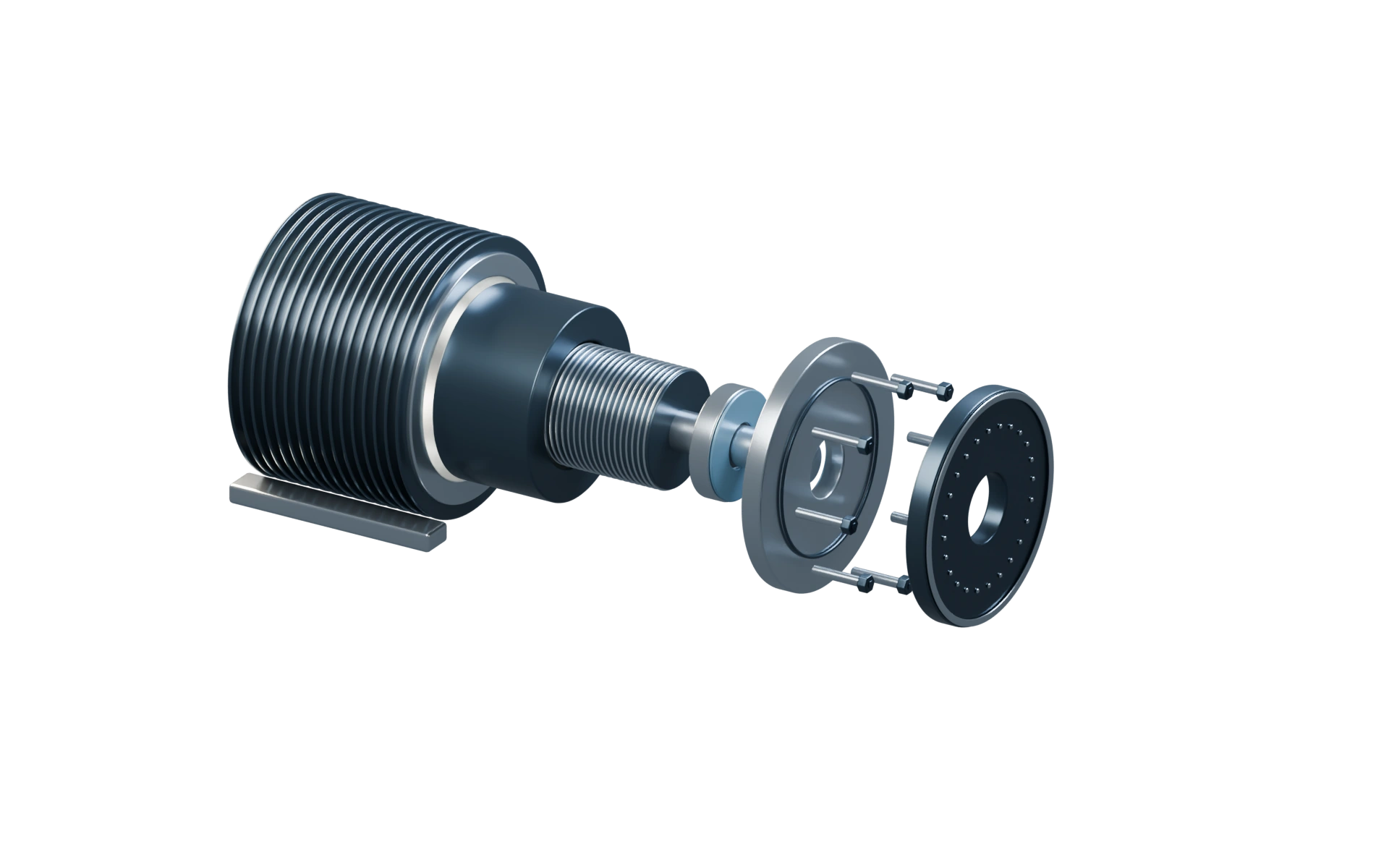
Parametric assembly study with housing, rotor, bearings and flanges

Document toolsWorkflow toolsAutoCADSOLIDWORKSKnowledge & business toolsTailored integrations
PARAMETRIC DESIGN / AGENT WORKFLOW STUDYEVIDENCE / AGENT WORKFLOW STUDY
CUSTOMER FILEEntity verificationIllustrative entity · Authorized sources
OWNERSHIPBeneficial owner
CROSS-CHECKRegistry records
SCREENINGName-match lead
AUDIT TRAILHuman verification
SOURCE / AIndustry report
SOURCE / BInterview notes
EVIDENCE SYNTHESIS

Research memorandum

Compare sources and retain supporting and conflicting evidence

A ↗B ↗C ↗
Illustrative analysis · Researcher review
SOURCE / CCompany filings
Architecture & engineering

Read design requirements and parameters

Design brief, dimensions, company standards and part templates

Produce reviewable work

Editable drawings / Parametric models / Check records

Illustrative custom workflow. Data access, business rules and deliverables are agreed per project; qualified people review key results.

UNVERIFIED LEADA name match needs further verificationRetain sources and links for compliance review
Scroll through the agent workflow

DEPLOYMENT & COMPUTE

Your workflow.
Your deployment choice.

We deliver AI applications and the compute and deployment services to run them. Choose an approach around your data requirements, workload and existing systems.

Discuss your use case
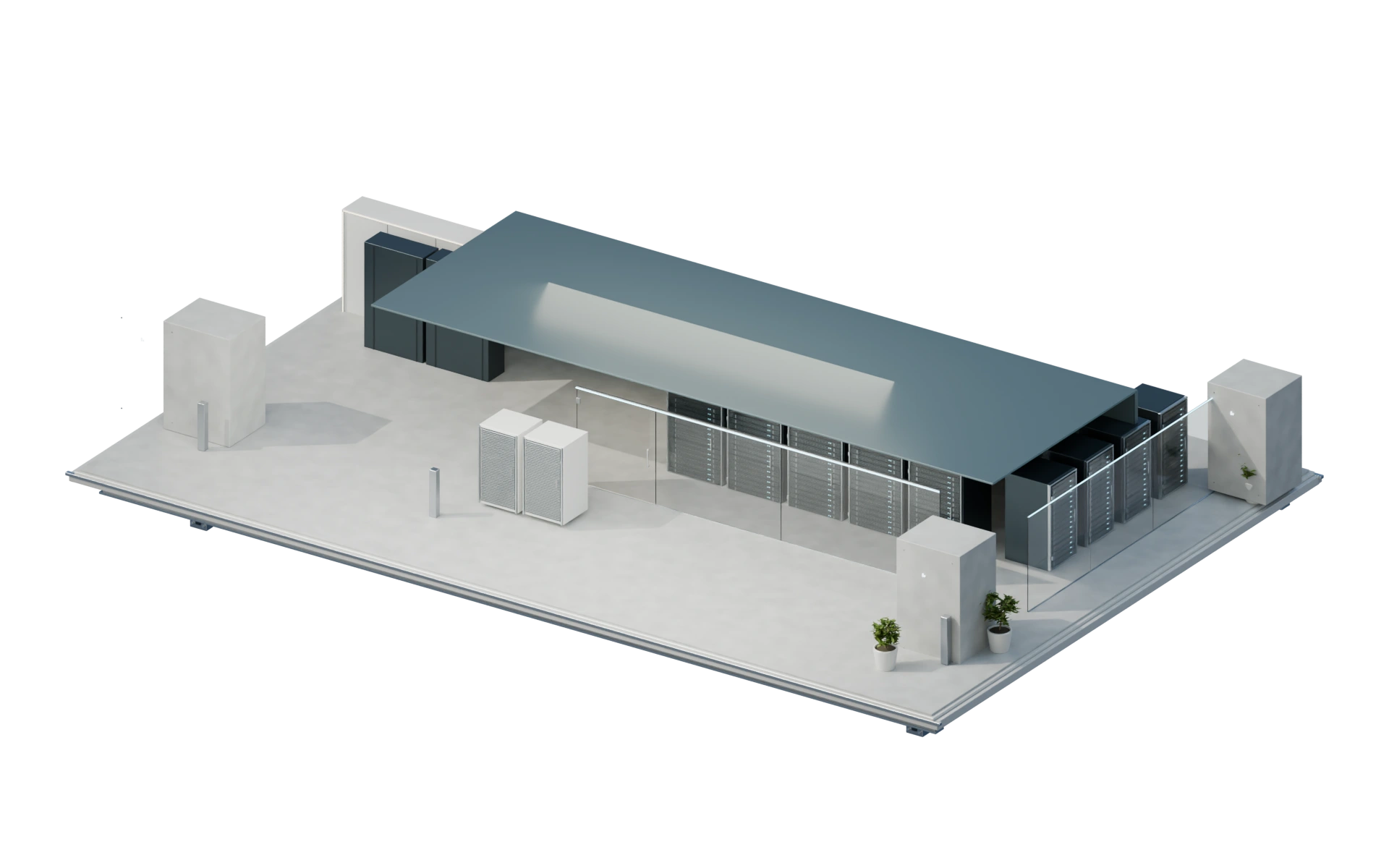
Local compute equipment and racks from the original architecture
INTOSYN / PRIVATE INFRASTRUCTURE

Cloud compute

Configure resources for your application, validate a use case and expand.

Private deployment

Connect knowledge, access controls and business systems within the agreed enterprise environment.

Compute cards & local hardware

Plan hardware, deployment and operations around your facilities and workloads.

COMPUTE YOU CAN HOLD

Compute in the cloud.
Or in your own environment.

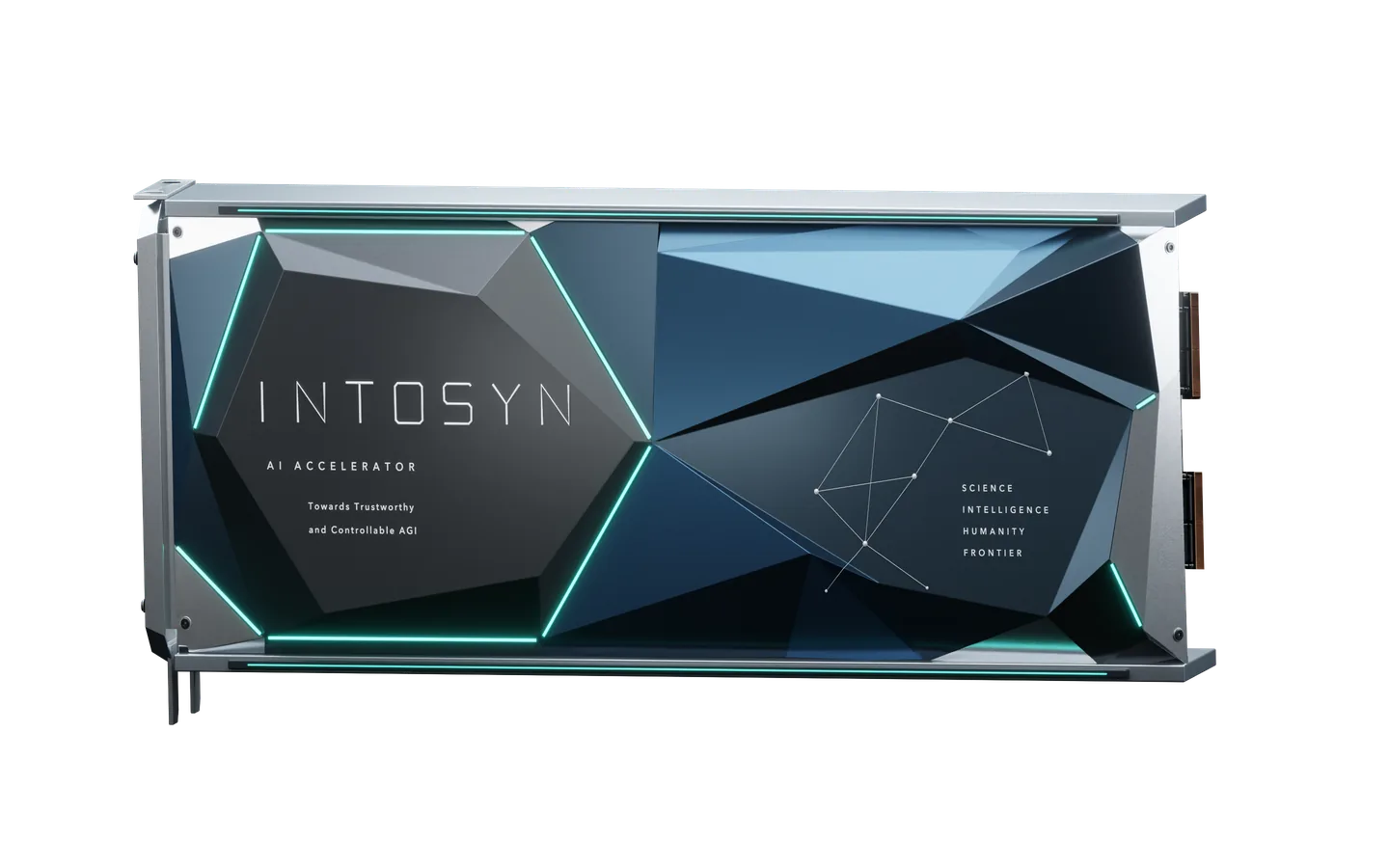
Run AI in the environment that fits your business. Scroll to unfold the INTOSYN compute card design.

INTOSYN GPUENCLOSURE STUDY

ON-PREMISES HARDWARE

Bring compute to your own environment.

Compute cards and local deployment solutions for businesses with existing infrastructure or a need to manage their own environment. Configuration and services are agreed for each project.

Discuss hardware & deployment

Enclosure and dual-core concept visualization. Delivered configuration depends on the agreed solution.

INTOSYN / LOCAL COMPUTE

BUILT FOR REVIEW

Traceable work.
Human accountability.

Permission-based access

Control access by person, project and document scope.

Source-linked results

Keep files, versions and source locations available.

Recorded activity

Trace retrieval, drafting, edits and approvals.

Professional review

Authorized people own key decisions and final sign-off.

A CLOSER LOOK

Explore the detail.
Evaluate the fit.

Review use cases, workflows, architecture and implementation scope.

Use cases & validation

Case Library

Scenarios and validation records

We publish these by evidence status: six scenarios have verifiable solution-validation material, while six remain demonstration environments. We do not present a demo as delivered, or solution validation as production deployment.

★ Featured evidence case

C1Solution validated

Feasibility-study first draft

Three people, two weeks. More than half the time is spent reading scanned documents, cross-checking current standards and retrieving past projects. The system handles the first-pass reading, comparison and retrieval.

TechnologyKnowledge governance · Retrieval augmentation · Multi-step agent orchestration
BoundaryTechnical routes, evidence approval and sign-off remain with people
C2Solution validated

Standards and mandatory-provision retrieval

Search hundreds of national, industry and local standards plus local supplements in natural language. Results include the applicable provision, source text, title, version, clause and mandatory-status marker.

TechnologyRAG · Version identification · Mandatory-provision tagging
PrincipleNo source, no delivery claim
C3Solution validated

Pre-submission compliance check

Before submission, check the drawing against the relevant standards and produce an issue list: what may not comply, which source and clause supports the finding, and what change may address it.

TechnologyRule execution + human review
BoundaryThis is a check, not a professional review; the registered engineer remains responsible for sign-off
C4Solution validated

Institution-specific model

The same standard can be applied differently by different practices. Some of those standards live in experienced engineers’ judgment rather than formal policy. Corpus governance → CPT → SFT/PEFT → preference alignment → evaluation and rollback.

TechnologyContinued pretraining · Fine-tuning · Alignment · Evaluation
BoundaryWe do not train a foundation model from scratch for every enterprise
C5Demonstration environment

Scenario simulation for design changes

A client requests a change in basement floor-to-floor height. Compare clear height, illustrative thresholds, cost estimates and review paths using explicit assumptions; real projects require separate validation.

TechnologyBounded industry world model · State transitions · Scenario simulation
BoundaryIt does not predict the real world or decide the enterprise’s future
C6Demonstration environment

Contract review and deviation analysis

Compare a contract clause by clause with the approved template, classify additions, deletions and rewrites, rank by risk, retrieve internal precedents and route high-risk clauses to counsel.

TechnologyAgent + Multi-version comparison + Timeline diff
BoundaryCounsel makes the risk determination and final recommendation
C7Demonstration environment

KYC review and regulatory-change scenarios

The standard flow extracts fields and matches lists. The scenario flow treats a new rule taking effect as an event and models risk migration, missing evidence and review-queue impact.

TechnologyAgent + World Model (financial services)
BoundaryIt does not replace the compliance professional’s final judgment
C8Demonstration environment

Intelligent review of material certificates

Extract manufacturer, grade, heat number, chemical composition, mechanical properties, heat treatment and NDT fields; compare them with specifications and standards; then archive the evidence after human-and-system review.

TechnologyStandards comparison + Human-and-system review + Provenance archive
BoundaryAssists review; it does not automatically determine acceptance
C9Solution validated

Zero-trust remote access

No public service ports are opened on the firewall. The on-premises server establishes an outbound connection to a relay; external endpoints use the same relay for the handshake. Transport is end-to-end encrypted and the relay holds no keys.

TechnologyPrivate network + Permission matrix + Full audit trail
BoundaryWe do not say “never leaves the environment” unless a fully offline architecture has been verified
C10Demonstration environment

Policy retrieval and approval traceability

The same question may produce different permitted evidence for different departments and roles. Access control is visible behavior, not a promise: out-of-scope requests are blocked or flagged and recorded in the audit log.

TechnologyPermission governance · Accountability traceability
BoundaryRetrieval, generation, edits, approvals and exports are logged
C11Solution validated

Past-project archive and experience reuse

Thousands of past projects may sit on servers under inconsistent names. When the original team moves on, the institutional memory disappears. Ask which mountain-hospital projects were done, and retrieve the project, approach, issues and final resolution together.

TechnologyKnowledge governance · Semantic archiving · Similar-project retrieval
ValuePeople move on; the capability remains
C12Demonstration environment

Research reports and investment-memo drafts

Organize industry research, company files and interview notes; extract risk factors; cross-check multiple sources; reuse prior frameworks and methods; and archive the evidence behind every conclusion.


TechnologyMulti-source verification · Framework reuse · Evidence archive
BoundaryThe system processes materials; analysts own judgments and conclusions
Try an interactive planning example

Interactive · Bounded industry world model

Change one parameter,
and see what moves

Working Definition

Enterprise world model = business ontology and state representation + real-world rules and constraints + state-transition and risk functions learned from historical data + scenario simulation and evaluation + human authorization

Move the slider to compare clear height, illustrative rule conflicts, estimated cost and schedule at different floor-to-floor heights.

This deterministic demonstration explains option comparison. It is not connected to project data, a regulatory database or a learned model.

Design change · Rule-based demonstration Demo
Basement floor-to-floor height BASE 3600mm 3400 mm
±0−100−200−300−400mm
Structure and MEP allowance 1200mm Actual clear height 2200mm Near demo threshold
Rule conflicts
0
Below the illustrative 2300mm coordination reserve.
Estimated cost
-CNY 500,000
Illustrative estimate in CNY, including earthwork savings and MEP changes; not a quote.
Estimated schedule
+12 days
Assumes 4 days per discipline plus 10 days for a threshold conflict.
Review path
Internal review
Actual approvals depend on the project, local codes and professional judgment.

Illustrative rules triggered

A height change triggers a structural reviewDemo assumption
Review MEP layout for a reduction of at least 150mmDemo assumption
Clear height is below the illustrative 2300mm reserveDemo assumption

Candidate options

Interactive demonstration: thresholds, costs and schedules are explicit assumptions, not code review, model predictions or a quotation. Selecting an option only compares it on this page; it does not execute, save or create an audit record. Real projects require current codes, jurisdiction and complete project conditions.

Capabilities & architecture

Capability Stack · Modular capabilities

Composable capability modules
on one shared foundation

Five technical capabilities are outlined below. The implementation combines models, retrieval and business tools around your materials, workflows, access permissions and professional rules.

01

Private boundary

Private AI Core

Models run in a customer-controlled environment. Compute, network, identity, logs, backups and version rollback define the control plane; sensitive data remains within the authorized boundary and external connections are explicitly configured.

  • Reverse outbound connection— The customer-side server establishes the outbound connection; no public service port is opened on the firewall.
  • Relay does not hold keys— Transport is end-to-end encrypted; the relay does not hold keys needed to decrypt business data.
  • Identity- and project-based access— Apply least-privilege access by person, project and data scope, with isolation, revocation and periodic review.
  • Full-process audit— Connections, retrieval, file access, configuration changes and model calls leave queryable audit records.
External Port Scan Secured

Traditional VPN exposure

443/tcp  open  https
1194/udp open  openvpn
3389/tcp open  ms-wbt
22/tcp   open  ssh

4 PORTS EXPOSED

Reverse outbound connection

—
—
—
—

0 PORTS EXPOSED

The security boundary is established by architecture and validation
02

Model factory

Domain Model Factory

The same standard may be interpreted and applied differently across institutions, with much of that judgment not captured in structured policy. A general model does not automatically know institution-specific knowledge and standards; the work is to build governed enterprise knowledge and task capability.

  • Corpus governance— Clean, deduplicate, classify and de-identify content; create a permission-tagged corpus ledger as the foundation for model adaptation.
  • Continued domain pretraining (CPT)— Absorb domain terminology, regulatory language, writing conventions and abbreviations so the model understands the domain consistently.
  • Task fine-tuning (SFT / PEFT)— Separate adapters by task or specialty and evaluate, release, update and roll them back independently.
  • Preference alignment and evaluation— Build preference data from historical review decisions and real tasks, with reviewable offline and production evaluation sets.
Model Registry · v2.4.1 Deployed
Corpus governance
1.8M documents
CPT
4.2B tok
SFT / PEFT
3 adapters
Preference alignment
12.6K pairs
Evaluation
PASS
Evaluation metricBefore adaptationAfter adaptation
Field-extraction accuracy71.4%93.8%
Citation completeness58.2%97.1%
Miss rate18.6%4.2%
Manual-edit rate62.0%21.5%

Illustrative interface · Metrics are planning targets estimated for comparable organizations, not commitments

03

Agent workflow

Agentic Workflow

The system goes beyond question answering. An agent receives tasks, identifies files, retrieves evidence, calls tools, applies rules and produces results while escalating missing information, conflicts and high-risk matters to people. Every step can be traced, reviewed and rolled back when needed.

  • Source text can be verified— Link output to source text and identify the standard, version, clause and applicability marker.
  • No evidence, no delivery claim— A feature without a source, version or validation path is not represented as a delivered capability.
  • Explicit conflicts and gaps— Mark missing information, conflicting conditions and out-of-scope cases instead of forcing a definitive answer.
  • Risk-based human escalation— Route high-risk or low-confidence matters to human review, with the automation boundary visible in the trace.
Agent Trace · Task #A-2291 Completed
  • 01INGEST · 47 client materials → classify and tagOK
  • 02PARSE · Scanned-document OCR → structured field extractionOK
  • 03RETRIEVE · Compare current standards (4 national / 2 local)OK
  • 04RETRIEVE · Retrieve the top five internal precedentsOK
  • 05TOOL · Call the cost-estimation APIOK
  • 06CONFLICT · Geotechnical data conflicts with planning conditionsEscalate
  • 07MISSING · Client materials lack the site-boundary planEscalate
  • 08GENERATE · Report outline + section points + baseline dataOK
04

Business world model

World Model

Represent business entities, states, constraints, actions and outcomes in a bounded industry world model. In regulatory, engineering, operating and risk scenarios, simulate option impacts first and give decision-makers an explainable evidence trail.

  • Scope and state space are explicit— Simulate only within defined business boundaries and state variables; do not extrapolate a bounded model into a real-world forecast.
  • Rule sources are traceable— Mandatory provisions, national/industry/local standards, local supplements, contract terms and internal practices retain source and version information.
  • Impact chains and evidence are visible— Trace the impact path across compliance, cost, schedule and approval; link every conclusion to its evidence and assumptions.
  • Decision and execution authority remain with people— Record options, selections and rationale as versioned audit entries; professionals make the final determination.
Try the simulator
Bounded World Model Simulating
Change event Entity state Rule hit Mandatory conflict Review required Human approval
SIMULATE BEFORE EXECUTE
05

Standing agent

Standing Agents

The earlier modules mainly support one-off task completion. Other work requires continuous monitoring: model clashes, drawing-version consistency, standards compliance, list changes and policy updates requirea rule-based monitoring mechanism that keeps running.

After configuring the monitored objects, rule set and notification policy, the agent runs on a schedule, scans continuously and reports only changes without repeated instructions.

  • Configure once, run continuously— Configure the scope, rules, alert levels and recipients together, with controlled updates later.
  • Report changes, not noise— Do not repeat the same issue; notify only on new, resolved or risk-level changes.
  • Alerts include evidence— Each alert includes the object ID, matched rule, model version and scan time for review.
  • Monitor continuously; do not replace decisions— The system detects and alerts; remediation, changes and sign-off remain subject to human approval.
Standing Agent · MEP clash inspection Running 14d 06h
  • 09:12Scan B3 MEP model v2.7 · 1,284 componentsCompleted
  • 09:143 clashes · duct × cable tray · clear distance < 50 mmEscalate
  • 11:40Scan B2 MEP model v2.7 · 1,102 componentsCompleted
  • 11:41No new clashes; two findings carried forward from the prior runNo change
  • 14:07Model version update detected v2.7 → v2.8Rescan
  • 14:23Full-building rescan complete · original 3 clashes resolvedCompleted
New alerts this round 0 Total escalations 17 Reviewed 17 Simulated data / illustrative interface

Reference Architecture · Private deployment

One diagram to make the boundary clear

Compute, network, identity, storage, model services, knowledge, agents, monitoring and audit need clear boundaries. This is one of the first deliverables before implementation.

Infrastructure INFRASTRUCTURE GPU server cluster Quantization · Inference optimization Multi-model scheduling Resource and concurrency management High-availability operations Backup · Monitoring Model services MODEL SERVING Inference service Institution-specific model Model registry Versioning · Rollback Evaluation dashboard Baseline comparison Knowledge governance KNOWLEDGE Corpus ledger Cleaning · Classification · De-identification Permission tags People · Roles · Projects Traceable citations Source text · Version Intelligent workflow AGENTIC Intake and identification Classification · Field extraction Retrieval and execution Evidence · Rules · Tools Human review Escalate to a person Business world model WORLD MODEL State graph Entities · States · Constraints Scenario simulation Change → Impact chain Option comparison Evidence · Confidence Office / OA systems Contracts / matter management Project management systems Risk / audit systems Human approval · approve / edit / return Record the rationale; create a new version and audit entry
  • No publicly exposed inbound portsExternal scans cannot reach services inside the boundary
  • Reverse outbound connectionThe on-premises server connects out to a relay; the relay holds no keys; transport is end-to-end encrypted
  • API integrationConnect to existing office, contract, project and risk systems without replacing the current information environment
  • People stay in the loopHigh-risk and uncertain matters go to human review; judgment and sign-off remain with people
Scope & responsibilities

Governance · Capability boundaries

Capability boundaries and
public language

This is not marketing language. It is our public description of product capability, conditions of use and accountability boundaries. We commit only to what can be validated, delivered and audited; the remaining boundaries are stated just as clearly.

Capability area
What we can substantiate publicly
Explicit boundaries and claims we do not make
Data security
Deployment can remain within a customer-authorized environment; external calls are explicitly configured by the enterprise; transport is end-to-end encrypted and relays do not hold decryption keys. The actual boundary depends on architecture, network policy and security validation, as well as applicable law and agreed data-processing terms.
We do not make a blanket “never leaves the environment” claim. A no-egress claim requires a verified fully offline architecture and appropriate controls.
Accuracy
Citations are traceable, versions are identifiable and evaluations are reviewable; high-risk matters retain human review and final decision authority.
We do not promise to eliminate every hallucination or claim 100% accuracy. Model output is not a fact or professional opinion without appropriate review.
Pretraining and adaptation
We support continued domain pretraining, supervised fine-tuning, parameter-efficient fine-tuning, preference alignment, distillation, quantization and evaluation to help customers build manageable, iterative model assets.
We do not promise to train a foundation model from scratch for every enterprise. The appropriate level of adaptation depends on data, compute, the target task and validation results.
World Model
Within a clearly bounded business domain, simulate state changes and option impacts using enterprise rules, historical data and explicit assumptions for scenario analysis and decision validation.
We do not claim to understand or predict the entire real world, decide an enterprise’s future, or present a bounded simulation as a real-world forecast.
Agent
Within its authorization, the agent can call tools, execute steps, record the process and escalate uncertain or high-risk matters to people.
We do not claim that an agent can handle every business process without supervision. It does not bypass permissions, approvals or accountable owners, and it does not replace professional judgment.
Continuous learning
Feedback can update knowledge, models or workflows; changes move forward only after testing, approval, version control and rollback validation.
The system is not allowed to change its production behavior without approval. Continuous updating is not uncontrolled self-evolution.
Project delivery process

Start small. Make it work.

You don’t need to transform the whole company at once. Start with one task and let the results guide the next step.

  1. Find the right task

    Tell us what takes time or causes errors. Redacted examples help us understand the workflow.

  2. Try a working version

    Test with real tasks. Check usefulness, investment and where human review is needed.

  3. Deploy, then grow

    Choose cloud or local deployment and connect the workflow. Stabilize one use case before adding the next.

Before you start

FAQ

Before you start.

Can we talk before I have a technical plan?

Yes. Describe the task, how you do it today and the problems you face. We’ll assess whether AI fits.

Do I need to buy a server first?

No. You can start with cloud compute or existing hardware. Deployment depends on the task, data requirements and budget.

Can we keep our existing systems?

We prioritize connecting existing systems. We first assess interfaces and permissions to identify what can connect and what needs adjustment.

How do we know it is worth the investment?

Agree on measures such as search time, throughput and review effort. Use pilot results to decide whether to expand.

LET’S PUT AI TO WORK

Start with one workflow.
Make progress measurable.

Bring a workflow, the tools you use and the result you want. Together, we’ll define the scope, review points and criteria for a focused pilot.

Discuss your use caseinfo@intosyn.com